SAP AI
/
feb 16, 2025
From reactive SAP AIF Error Handling to autonomous AI resolution - lessons from 2025
In 2025, SAP teams faced the same recurring SAP AIF challenges: repetitive errors, unclear ownership, and manual processes that don’t scale. This article shares real project lessons and explains how AI agents, Joule, and SAP AIF APIs enable autonomous error categorization, prediction, and resolution. A practical look at how SAP operations can move from reactive firefighting to AI-driven, proactive interface management.
/
AUTHOR

Mateusz Kwaśniewski
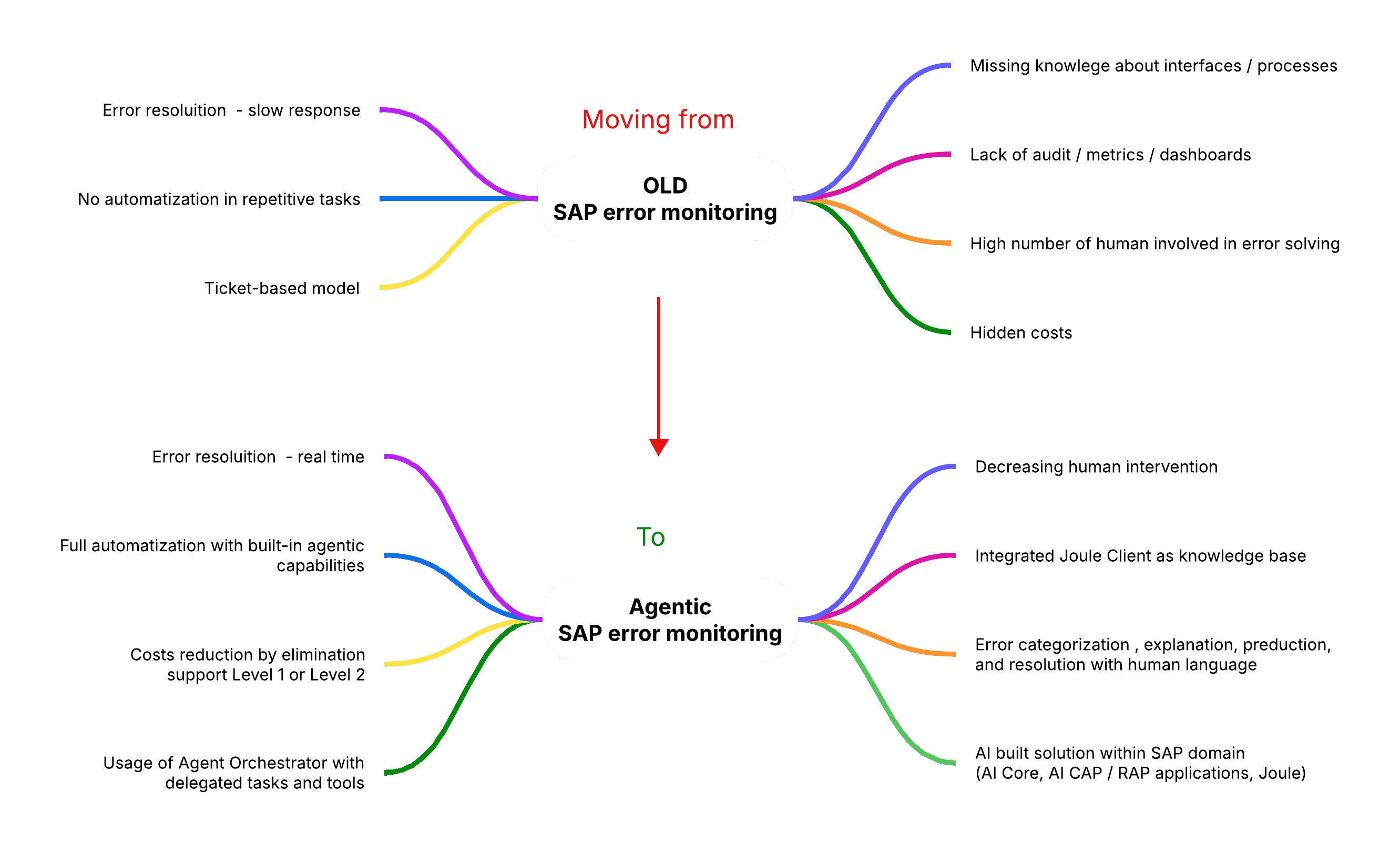
2025 was intense for many SAP teams we worked with. Different industries, different landscapes, but surprisingly similar problems when it came to SAP AIF error handling.
What we kept seeing in real projects:
Interfaces no one fully “owned” anymore
Errors bouncing between teams because responsibility wasn’t clear
The same issues coming back every month
Fixes that should take minutes, taking hours or days
A lot of knowledge locked in people’s heads, tickets, or old Confluence pages
None of this was caused by lack of skill. It was caused by scale, complexity, and manual processes that no longer fit today’s SAP landscapes.
A real example (one of many)
An invoice interface failed because of a missing value mapping. Classic AIF error.
What followed:
Ticket created
L1 analysis
Escalation to L2
Someone searched documentation
Someone else checked configuration
Fix applied
Same error returned weeks later
Nothing “wrong” happened - but nothing improved either. That pattern repeated itself across:
Finance postings
IDoc integrations
Proxy / RFC interfaces
Country-specific eDocument scenarios
What we learned
Most AIF errors are predictable Not all, but many follow patterns: missing config, invalid master data, missing mappings, low quality of input data
Resolution knowledge already exists - just not where it’s needed In tickets, Jira, SharePoint, Confluence, chat messages… scattered and hard to reuse.
Humans shouldn’t be the first line of reaction anymore Especially for known, repetitive problems.
SAP finally has the building blocks to change this Document Grouding, Agents, Joule, AIF APIs - all inside the SAP ecosystem.
Where this led us
Instead of asking “how do we fix this error faster?” we started asking:
SAP AI agents for AIF monitoring
Customers started asking a simple question: “Can AIF tell us what to do before we open a ticket?” So we introduced an AI assisted AIF monitoring layer, built directly on top of SAP AIF.
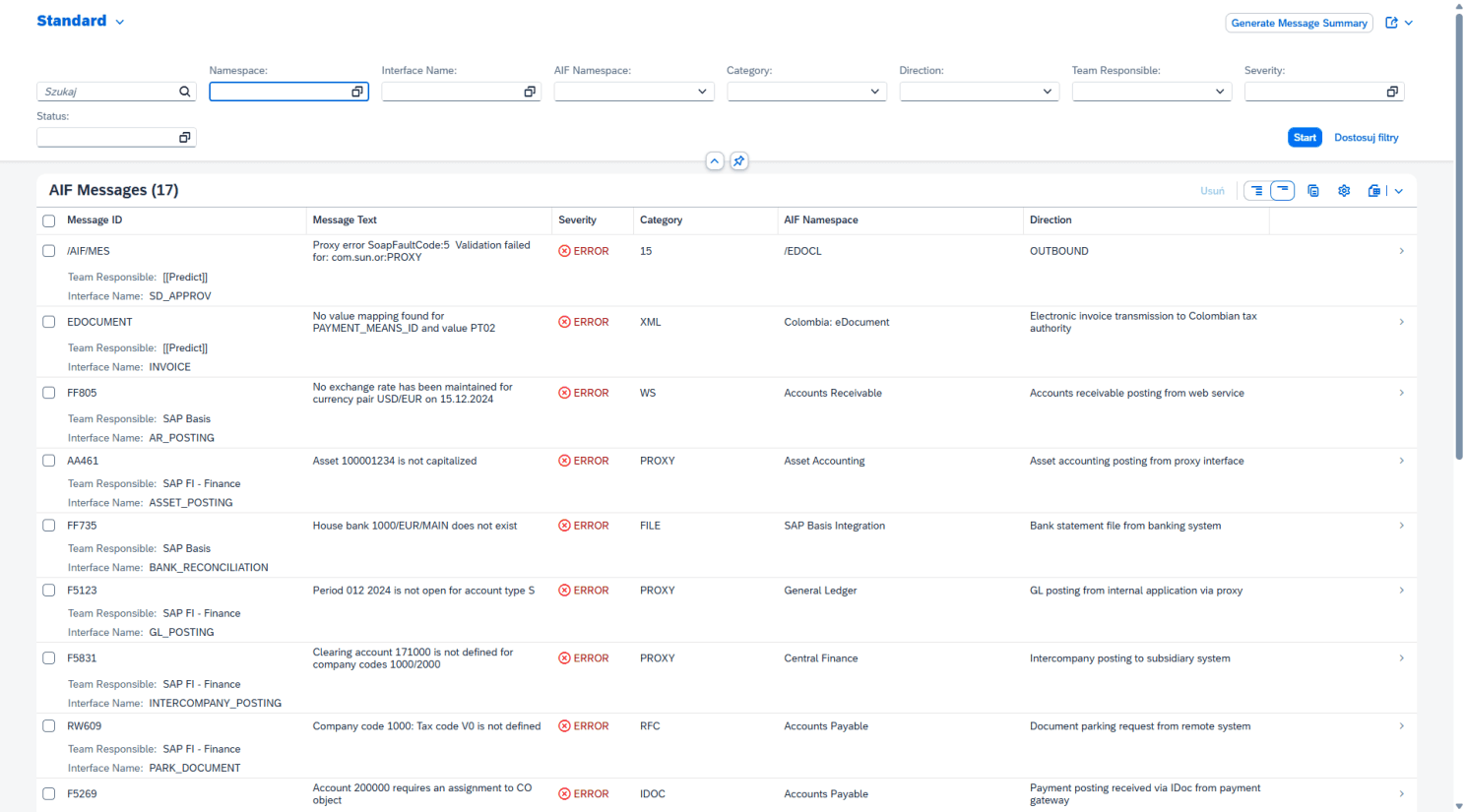
AIF messages with AI predicted fields ( ex. Team Responsible ):
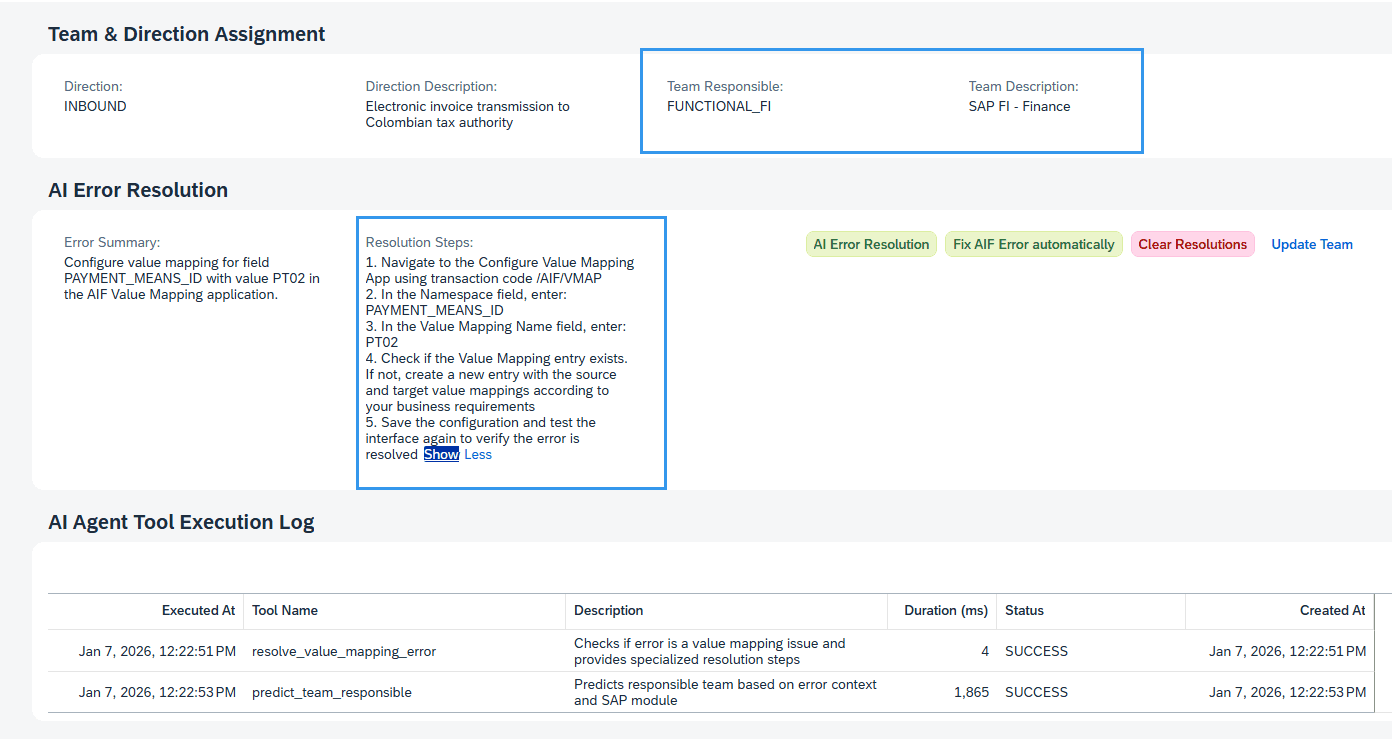
AIF error resolution supported by SAP AI
What it enables in practice:
Automatic categorization of AIF errors
Prediction of responsible team and direction
Error explanations in human language (not SAP error codes)
Resolution steps generated from past incidents and documentation
Agent execution logs instead of ticket back-and-forth
Learn from previous resolutions
Involve a human only when needed
Behind the scenes, AI agents work with:
SAP AIF context and message payloads
Existing customer knowledge (Confluence, Jira, SharePoint)
SAP AI Core + Joule + CAP/RAP applications
All inside the SAP ecosystem. The goal was to remove repetitive firefighting and let people focus on real problems. This is how AI starts to feel useful in SAP operations.
What we’re working towards in 2026
Based on what we faced in 2025 projects, our focus is on:
Autonomous resolution of known AIF error patterns
Real time reaction instead of ticket queues
Using existing customer knowledge as a living knowledge base
Predicting errors before business users notice them
Keeping everything inside the SAP domain (no data leaving SAP)
If you’re responsible for SAP interfaces, AIF, or SAP operations and this sounds familiar - you’re definitely not alone. We are curious how others are approaching this in their landscapes.