/
CASE STUDIES
/
2022
/
SKF
SAP AIF Driven Transport Management Integration at SKF


/
CLIENT
SKF
Visit site
/
SERVICES
SAP Transportation Management (TM)
SAP AIF
SAP CPI
SAP ABAP OO
SAP Integration
SAP S/4HANA
/
OVERVIEW
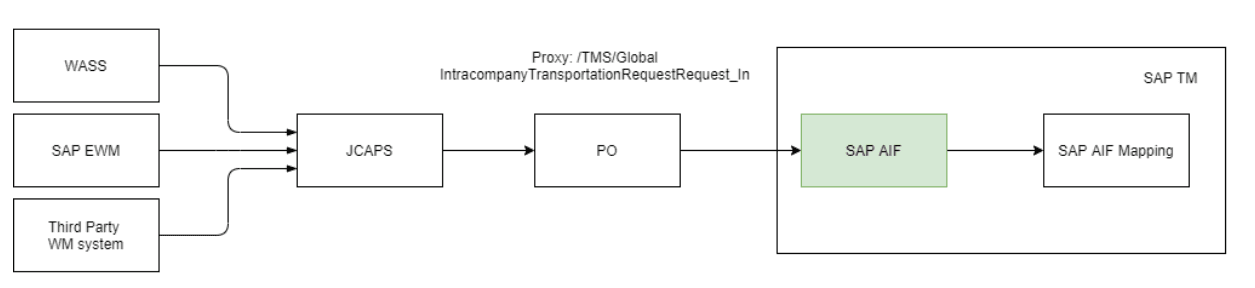
SKF implemented SAP Application Interface Framework (AIF) in the SAP Transportation Management (TM) module to stabilize and operationalize inbound Transportation Request processing. The solution was built around the standard TM inbound interface, enhanced with AIF capabilities for validation, monitoring, correction, and controlled reprocessing.
Intra Company Transportation Request used by SKF is a standard SAP TM inbiund service that supports internal logistics coordination within a global organization. Its role is to ensure that transportation needs generated by internal supply chain processes are correctly transferred into SAP TM so that planning, execution, and monitoring can happen without disruption.
In standard SAP, this service is delivered with ECH (Error and Conflict Handler) enabled, meaning failed messages are technically logged and reprocessed via SXMB_MONI, with limited business transparency.
/
CHALLENGES
Why Standard Processing Was Not Sufficient
In SKF’s landscape, the service handled high-volume, multi-country, intra-company transportation requests. The main limitations of the standard setup were:
Errors caused by country-specific address and postal code formats
Missing or inconsistent master data (regions, cities, postal codes)
Technical error handling via ECH that was not usable by business teams
No structured way to correct payload data and safely reprocess messages
Repeated errors with identical root causes
This made the standard ECH-based processing unsuitable for operational logistics teams.
If the same data errors keep coming back, is the problem really technical?
/
SOLUTIONS
SAP AIF Enablement Approach for the Service
To overcome these issues, the service was migrated from ECH-based handling to SAP AIF, using the same standard proxy but with a different execution model:
ECH framework was disabled for this interface
Interface logic was executed via Proxy Engine, controlled by AIF
Full AIF feature set was activated: mapping, checks, monitoring, restart, and payload correction
Key AIF Capabilities Applied
Structured Mapping & Validation
The inbound XML structures (e.g. Consignee Party, Ship-To Location) were mapped using AIF structure mappings with controlled execution order.
This allowed SKF to introduce deterministic and reusable mapping logic instead of custom code in the proxy.
BRF+ Driven Address & Country Logic
AIF was combined with BRF+ decision tables to handle country-specific inconsistencies:
Country derivation based on organization and city
Region mapping rules (e.g. Brazil-specific logic)
Postal code normalization per country (Brazil, Canada, non-EU rules, T005 templates)
This moved fragile logic out of ABAP and into maintainable business rules.
Controlled Payload Correction
AIF was configured with explicitly changeable fields in the message payload (addresses, postal codes, region codes). Business users could correct errors directly in the AIF UI and reprocess messages safely without re-triggering the source system.
Business-Oriented Monitoring in Fiori
SKF used AIF Monitor in Fiori Launchpad, giving business users better visibility and accessibility from web browser.
Recipient & Responsibility Model
The interface introduced recipient determination based on business keys (e.g. shipper country).
Errors were routed automatically to region-specific teams, with a fallback group for unmatched cases
/
RESULTS
Resulting Role of the Service After AIF Enablement
After AIF implementation, Intra Company Transportation Request evolved from a purely technical inbound interface into a controlled, business-operable integration process:
Predictable processing of transportation requests
Reduced reoccurring errors through rule-based validation
Business self-service for correction and reprocessing
Scalable handling of global TM data complexity
From an SAP TM functional perspective, this is a textbook example of how standard enterprise services become enterprise-ready when wrapped with AIF.
60-70%
reduction in transportation request processing disruptions
50%
faster resolution of logistics exceptions
40%
decrease in recurring data-related errors
/
CASE STUDIES